
Modern beverage manufacturing is undergoing a dramatic evolution. High-capacity co-packers and high-mix production facilities are no longer just running dedicated, single-product lines. Instead, they are continuously switching between complex schedules that span craft beers, functional energy drinks, plant-based milks, and botanicals.
This shift introduces severe operational challenges, particularly around cross-contamination, allergen control, and production downtime. Clean-in-Place (CIP) systems are the unsung heroes of this environment. To remain competitive, beverage processors must look past basic timed cycles and transition toward advanced CIP skid designs that utilize turbulent flow physics and sensor intelligence to optimize sanitation.
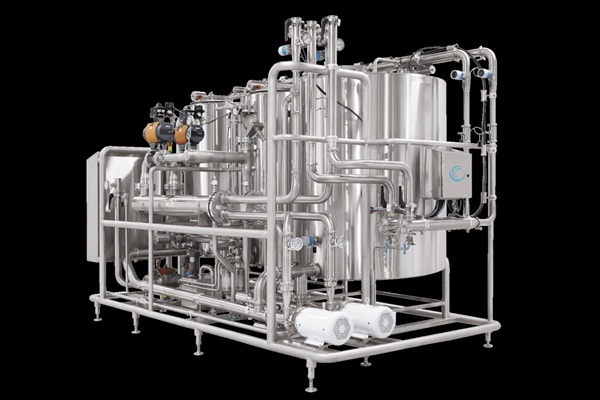
How Do You Size Central CIP Systems to Eliminate Filler Bottlenecks?
When managing a high-mix beverage facility, a poorly sized CIP system quickly becomes a bottleneck, forcing million-dollar fillers to sit idle while waiting for a sanitation cycle to finish. Correctly scoping an automated CIP system requires evaluating three critical operational dimensions:
- Total Equipment Inventory: Mapping every tank, filler, and line that requires cleaning across the entire plant footprint.
- Production Schedules: Analyzing which lines run simultaneously and how quickly specific equipment must be turned over for the subsequent product batch.
- Product-Specific Sanitation Profiles: Understanding that a sticky, protein-rich dairy alternative or functional beverage requires a significantly different cleaning procedure than a light craft lager.
By calculating these variables from a Gallons Per Minute (GPM) perspective, engineers can design and option centralized CIP skids that deliver the precise volumetric flow needed. This ensures that cleaning cycles are executed dynamically, preserving filler capacity and protecting the facility’s overall equipment effectiveness (OEE).
How Does Automated Inline Chemical Dosing Prove Its ROI Over Manual Titration?
Many legacy processing plants still rely on manual titration or basic, timed chemical injections for their CIP washes. This approach introduces massive variability, resulting in spikes of chemical waste, prolonged flush times, and excess water usage.
Transitioning to an engineered CIP skid featuring inline chemical concentration monitoring transforms resource management. To build an accurate Return on Investment (ROI) model for this upgrade, facilities should track and compare operational data over a one-year period:
Operational Comparison: Manual vs. Automated CIP Performance
Data Logging
- ░░░ [10%] Manual / Timed Dosing
- ████████████████████ [100%] Automated Inline Skid
Cycle Consistency
- ████████ [40%] Manual / Timed Dosing
- ███████████████████ [95%] Automated Inline Skid
Chemical Overuse & Waste
- ██████████████████ [90%] Manual / Timed Dosing
- █████████ [45%] Automated Inline Skid
Water Overconsumption
- █████████████████ [85%] Manual / Timed Dosing
- ███████ [35%] Automated Inline Skid
Automated systems smooth out the wild spikes inherent in manual operations by injecting precisely what is needed, when it is needed. Over a single fiscal year, the compounding savings in raw chemical costs, water procurement, and wastewater discharge fees easily justify the capital expenditure of the skid.
Centralized Multi-Tank Skids vs. Localized Mobile Carts: Which Fits Your Footprint?
For regional craft breweries and emerging functional beverage plants, floor space represents premium real estate. Choosing between a centralized multi-tank CIP system and a fleet of localized, mobile brewery CIP carts requires analyzing specific spatial and operational metrics.
- Physical Layout Constraints: Distance between the tank farm, processing area, and bottling lines can become an infrastructure constraint. While mobile carts offer perceived flexibility, transporting them across vast distances can introduce unexpected labor overhead and safety hazards.
- Frequency of Cleaning Cycles: A major pitfall of mobile carts is that despite being on wheels, they frequently end up sitting in one permanent location due to the constant demand for cleaning.
- Footprint Optimization: If a mobile cart remains stationary, it becomes an awkward, obstructive footprint in the middle of the production floor. In these scenarios, a centralized multi-tank system tucked into a corner frees up more usable space while providing superior fluid dynamics and volumetric capacity.
Data Logging and Validation: An Insurance Policy Against Allergen Risks
In an era dominated by plant-based alternatives and complex botanicals, allergen cross-contamination is a catastrophic brand risk that can shut down a facility entirely. Advanced CIP skids serve as a brand insurance policy through sophisticated automation and sensor intelligence.
Modern tracking software monitors virtually every drop of liquid passing through the system. By combining robust programmable logic controllers (PLCs) with incredibly accurate flow and conductivity meters, these systems capture real-time, stored data for strict QA/QC compliance.
If an operational parameter drops below specification, operators can react instantly before a batch is compromised. Furthermore, co-packers can seamlessly transmit this validation data to their brand clients as undeniable proof that every sanitation protocol was flawlessly executed, eliminating human error from the compliance equation.
Environmental and Sustainability Impacts of Engineered CIP Design
Modern manufacturing standards demand an aggressive pivot away from resource-intensive manual processes toward eco-friendly production. The technical methods utilized in advanced CIP skids—such as inline blending, hot CIP recirculation, and targeted fluid dynamics—significantly reduce energy draw during multi-step, multi-hour procedures.
A standout feature in sustainable skid design is the integration of specialized recovery tanks, particularly for caustic recovery. These tanks capture the final rinse water from a completed cycle and repurpose it as the initial pre-rinse for the subsequent cycle.
This process dramatically lowers chemical usage and minimizes wastewater volume. As states tighten regulatory standards on chemical disposal and effluent surcharges, utilizing advanced recovery loops protects both the environment and the facility’s bottom line.
By replacing legacy, manual sanitation procedures with advanced CIP skid architectures driven by real-time sensor data, beverage processors can successfully protect their brands, reduce resource consumption, and unlock maximum operational throughput.
Is your CIP circuit actually cleaning?
Enter your circuit and cycle. This returns your flow velocity against the scouring benchmark, your Reynolds regime, and what the cycle costs you across a year with line time counted.
gallons per minute
degrees F
Flow velocity
—
benchmark 5.0 ft/s
Reynolds number
—
—
Flow to hit 5 ft/s
—
—
—
—
Reynolds number and velocity answer different questions. Water goes turbulent by Reynolds at speeds well below what removes soil, so a circuit can read fully turbulent and still fail to clean. The 5 ft/s benchmark is the one tied to wall shear and mechanical scouring. Pass both.
gallons, all steps
dollars per 1,000 gal
dollars
dollars per MMBtu
contribution, not revenue
Line hours returned
—
per year
Equivalent
—
full production days
Utilities saved
—
water, chemical, heat
Annual value at stake
—
This is the ceiling, not a quote. A CIP intervention costing less than this returns its cost inside twelve months on your own numbers.
Assumptions. Velocity uses 0.4085 × GPM ÷ ID² on nominal sanitary tube wall thickness. Reynolds uses water density and viscosity interpolated to your solution temperature, so a caustic or acid solution will differ slightly. Thermal energy assumes heating from 60°F at 80% boiler efficiency with no heat recovery, so reduce it if you reuse or recover solution. Line value should be contribution margin per hour, not revenue, and it is the input that moves the total most.
Leave a Reply